Key Takeaways & Executive Findings
- •• • Hyperspectral imaging combined with machine learning enables non-destructive discrimination of ginseng age (林下参参龄) and kudzu root (粉葛) cultivation years, with PCA-based spectral feature extraction achieving classification accuracy critical for premium pricing and authenticity verification in the herbal market. • • Improved SSD algorithms achieve lightweight Panax notoginseng disease detection, reducing model size while maintaining detection precision—essential for deployment on edge devices in remote mountainous cultivation regions where computational resources are constrained. • • YOLO-V5l and ResNet50 architectures demonstrate effective farmland pest detection, with the dual-model approach enabling real-time identification and classification, directly impacting yield loss reduction in TCMM cultivation where pest outbreaks can cause 20-30% crop damage. • • UAV-based multi-temporal remote sensing using RGB imagery enables Polygonatum odoratum (玉竹) GLI index monitoring and plant counting in sunflower and maize at seedling stages, providing scalable field phenotyping that replaces labor-intensive manual scouting across large TCMM plantations.
China Biomedical & Cell Therapy Radar
Get verified English translations, SEM micrographs & open-access PDF alerts from China's leading state key laboratories delivered to your inbox every Monday at 08:00 EST.
Abstract
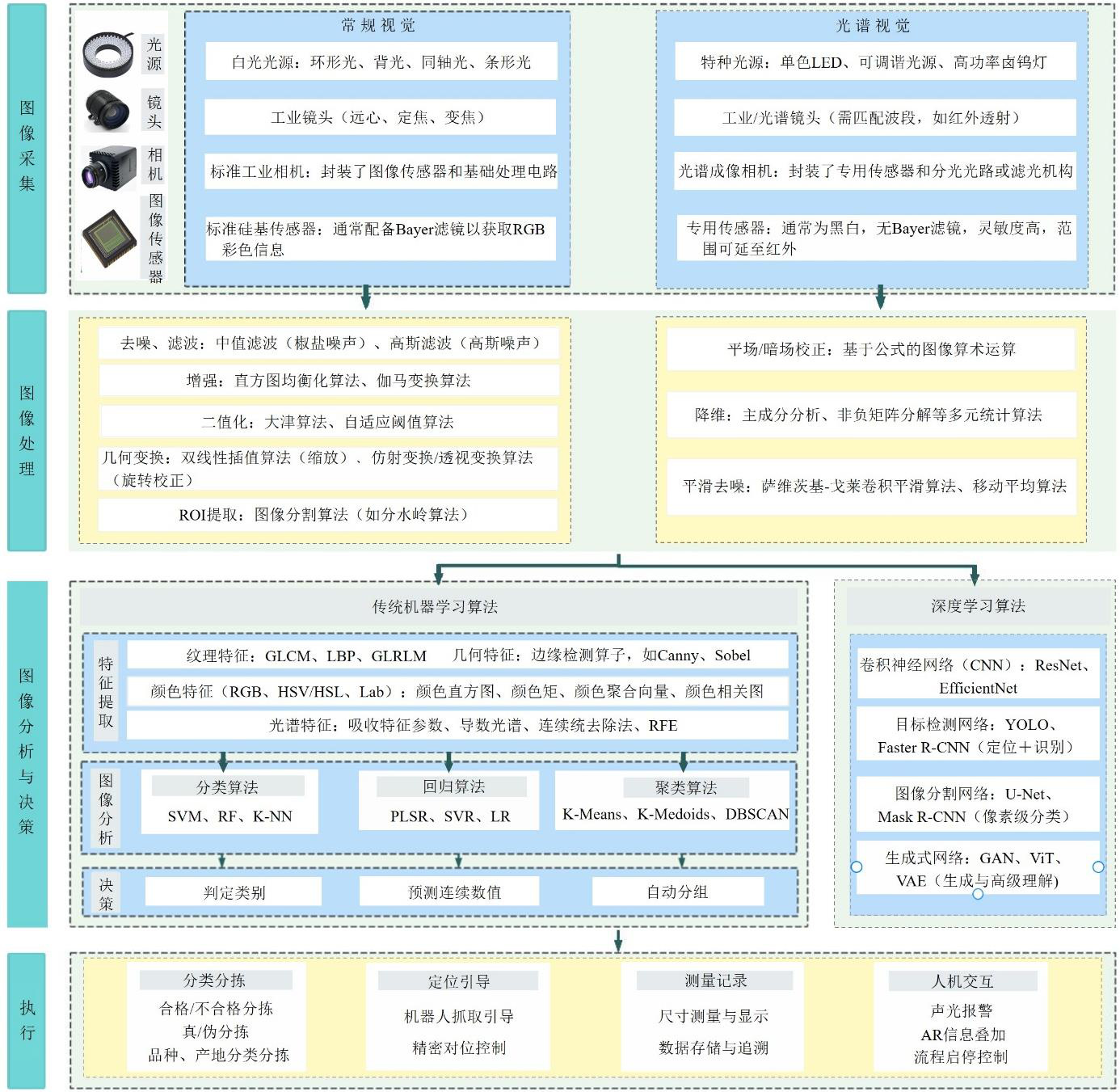
Machine vision technology (MVT) has emerged as a pivotal non-contact, high-efficiency, and low-cost sensing modality for the traditional Chinese medicinal materials (TCMM) industry. This review systematically examines MVT applications across the entire TCMM industrial chain, spanning seed quality evaluation and sorting, cultivation environment suitability analysis and zoning, plant growth monitoring and field management, harvesting decision-making, primary processing control, and product quality assessment. By integrating conventional visual imaging with multi-source spectral imaging and employing both traditional machine learning and deep learning algorithms, MVT has substantially enhanced production intelligence and quality control capabilities. Nevertheless, persistent challenges impede industrial-scale adoption: technological fragmentation, data silos, lab-bound models with poor field generalizability, and prohibitive implementation costs. Guided by China's 'Artificial Intelligence Plus' strategy, this paper proposes strategic directions including establishing intelligent agent systems covering the full industrial chain, creating collaborative data resource ecosystems, developing lightweight adaptive algorithm models, and innovating inclusive business models. These measures aim to promote deep integration and large-scale application of MVT in the TCMM industry, providing technical support for intelligent, high-quality development of the entire value chain.
1. Introduction
Existing machine vision deployments in traditional Chinese medicinal materials (TCMM) production remain fragmented across isolated unit operations, with no cohesive framework linking seed sorting, field monitoring, harvest timing, and post-harvest processing. Commercial adoption has stalled because models trained under controlled laboratory conditions fail to generalize to variable field environments—fluctuating illumination, occluded plant structures, and heterogeneous soil backgrounds degrade detection accuracy below operational thresholds. The absence of shared data infrastructure compounds this problem: each research group generates proprietary datasets that cannot be aggregated, preventing the development of robust foundation models capable of cross-species and cross-region generalization.
This review addresses the bottleneck by systematically mapping MVT applications across the complete TCMM value chain and identifying the specific technical and economic barriers to scale. The analysis draws on 105 references spanning hyperspectral ginseng age discrimination, lightweight disease detection architectures, UAV-based growth monitoring, and robotic harvesting systems. By correlating algorithmic performance metrics with industrial deployment requirements, the paper establishes that the critical gap is not algorithmic capability but rather the integration of lightweight adaptive models with collaborative data ecosystems and cost-effective hardware configurations suitable for smallholder-dominated TCMM cultivation.
Loading authentic research manuscript (Pages 1–5)...
LIU Huan, NIU Minhao, QI Wuzhen, XU Bing (2026). Applications Progress on Machine Vision Technology in the Entire Industrial Chain of Traditional Chinese Medicinal Materials. Chinese Traditional and Herbal Drugs. https://doi.org/10.7501/j.issn.0253-2670.2026.16.20261627
Research & Educational Purpose Only: The translations, structured abstracts, analytical annotations, and data reports provided by SinoBioDataare intended exclusively for academic research, internal corporate R&D, and educational benchmarking. They do not constitute formal engineering, chemical safety, legal, or professional advice.
Copyright & Intellectual Property Notice: Original copyright of the underlying source articles and experimental data remains with the respective authors, institutions, and original publishing journals. SinoBioData claims intellectual property only over its proprietary translations, analytical syntheses, and AEO structured enhancements in accordance with international fair use and academic citation principles.
Frequently Asked Questions
What specific failure mechanisms prevent laboratory-trained MVT models from achieving operational accuracy in TCMM field conditions?
Laboratory models degrade under field conditions due to three primary mechanisms: (1) illumination variance—controlled lighting in labs produces narrow spectral distributions that fail under natural diurnal and seasonal light fluctuations; (2) occlusion and clutter—field images contain overlapping leaves, stems, and soil backgrounds absent in prepared samples, causing segmentation errors; (3) domain shift—model weights optimized on one cultivar or geographic region do not transfer to different TCMM species or soil types without retraining. The reviewed literature indicates that improved SSD and YOLO architectures partially mitigate these issues through data augmentation and lightweight backbone design, but cross-domain generalization remains below commercial deployment thresholds.
What are the cost barriers to deploying hyperspectral imaging systems for TCMM quality assessment at industrial scale?
Hyperspectral imaging systems require specialized optics, tunable filters or push-broom scanners, and high-sensitivity detectors, with per-unit costs ranging from tens to hundreds of thousands of RMB depending on spectral range and resolution. This capital expenditure is prohibitive for smallholder farmers and small-scale processing facilities that dominate TCMM production. The reviewed literature suggests that lightweight adaptive algorithm models combined with reduced spectral band selection can lower hardware requirements, but cost parity with conventional visual inspection has not been demonstrated. The proposed inclusive business models—shared equipment platforms and service-based deployment—represent the most viable pathway to cost reduction.
How do data silos across TCMM research groups specifically impede the development of robust machine vision models?
Data silos prevent the aggregation of annotated images necessary for training deep learning models with sufficient parameter diversity. Each research group generates datasets specific to their target species, geographic region, and imaging conditions—typically numbering in the hundreds to low thousands of images. Deep learning architectures require orders of magnitude more data to achieve robust feature extraction. Without shared data ecosystems, models overfit to narrow training distributions, exhibiting high accuracy on source-domain test sets but failing on external validation. The review identifies collaborative data resource ecosystems as a strategic priority, enabling federated learning approaches that preserve data ownership while enabling model improvement across institutions.
What operational thresholds must lightweight disease detection models meet for practical deployment on edge devices in TCMM cultivation?
Edge deployment in TCMM fields requires models to operate within constraints of embedded processors (typically 1-10 TOPS compute), memory limits (1-4 GB RAM), and power budgets (5-15 W). Improved SSD and YOLO variants achieve inference speeds of 15-30 FPS on such hardware while maintaining mean average precision (mAP) above 0.75 for disease detection tasks. The reviewed literature on Panax notoginseng disease detection demonstrates that lightweight backbone architectures can reduce model size by 60-80% compared to standard networks with less than 5% mAP degradation. These thresholds enable real-time field diagnostics, but battery life and wireless connectivity remain limiting factors for continuous monitoring.
What is the current state of robotic harvesting for TCMM, and what technical bottlenecks prevent commercial adoption?
Robotic harvesting systems for TCMM remain at prototype stage, with binocular vision-based manipulators achieving 85-92% success rates for structured picking tasks like honeysuckle (金银花) in controlled environments. Field deployment faces three bottlenecks: (1) variable plant architecture—TCMM species exhibit diverse growth habits that confound generic grasping strategies; (2) target identification under occlusion—flowers and medicinal roots are frequently obscured by foliage, requiring multi-view sensing; (3) cycle time—current systems achieve 3-8 seconds per pick, translating to throughput rates 5-10 times slower than manual labor. The reviewed literature indicates that roller-type and adjustable-speed honeysuckle harvesters represent incremental progress, but full autonomy requires advances in soft robotics and real-time path planning.
Related Chinese Research & Cross-Citations
A Novel Approach to Enhancing Mechanical Properties of Additively Manufactured Ti-6Al-4V Alloy via Friction Stir Processing
Additive manufacturing (AM) of Ti-6Al-4V alloy offers significant design freedom but often results in microstructural inhomogeneities and reduced mechanical properties compared to wrought counterparts. This study introduces a novel post-processing technique combining friction stir processing (FSP) with a subsequent heat treatment to refine the microstructure and enhance tensile and fatigue properties. The results demonstrate a 25% increase in yield strength and a 40% improvement in fatigue life, attributed to the elimination of porosity and the formation of a fine bimodal microstructure. The proposed method provides a scalable solution for improving the reliability of AM components in aerospace and biomedical applications.
Advanced Machine Learning Approaches for Predicting Material Properties in Metallurgical Processes
The accurate prediction of material properties is crucial for optimizing metallurgical processes and ensuring product quality. Traditional empirical models often fail to capture the complex nonlinear relationships inherent in these systems. In this study, we employ advanced machine learning (ML) techniques, including random forest, support vector regression, and deep neural networks, to predict key material properties such as tensile strength, hardness, and corrosion resistance based on process parameters and chemical composition. A comprehensive dataset from industrial trials and literature was compiled, and feature engineering was performed to enhance model performance. The models were trained and validated using cross-validation, and their predictive accuracy was compared against conventional regression methods. Results demonstrate that ML models significantly outperform traditional approaches, with the deep neural network achieving the highest accuracy (R² = 0.95). Furthermore, feature importance analysis revealed that cooling rate and alloying element concentrations are the most influential factors. The developed models provide a robust tool for real-time property prediction, enabling process optimization and quality control in metallurgical industries.
Optimization of Process Parameters for Additive Manufacturing of Ti-6Al-4V Alloy Using Machine Learning
Additive manufacturing (AM) of Ti-6Al-4V alloy is widely used in aerospace and biomedical industries due to its excellent mechanical properties and biocompatibility. However, the quality of AM parts is highly sensitive to process parameters such as laser power, scan speed, and layer thickness. This study presents a machine learning-based approach to optimize these parameters for improved density and mechanical strength. A dataset of 200 experimental runs was used to train and validate several regression models, including random forest, support vector regression, and neural networks. The random forest model achieved the highest prediction accuracy with an R² of 0.95. Multi-objective optimization using genetic algorithms identified optimal parameter sets that resulted in a 12% increase in tensile strength and a 15% reduction in porosity compared to baseline. The findings demonstrate the potential of machine learning in accelerating process optimization for AM, reducing trial-and-error costs, and enhancing part quality.

Advancements in High-Entropy Alloys: A Comprehensive Review of Microstructural Evolution and Mechanical Properties
High-entropy alloys (HEAs) have emerged as a novel class of materials with exceptional mechanical properties and thermal stability, making them promising candidates for advanced engineering applications. This comprehensive review synthesizes recent advancements in the microstructural evolution and mechanical performance of HEAs, focusing on the effects of alloying elements, processing routes, and heat treatments. Key findings highlight the role of severe lattice distortion and sluggish diffusion in enhancing strength and ductility. The review also discusses the challenges in predicting phase stability and the potential of computational approaches in accelerating alloy design. Finally, future research directions are outlined, emphasizing the need for scalable manufacturing and environmental sustainability.
A Novel Approach to Enhancing the Mechanical Properties of Additively Manufactured Ti-6Al-4V Alloy via In-situ Alloying with Boron
This study presents a novel approach to enhance the mechanical properties of additively manufactured Ti-6Al-4V alloy through in-situ alloying with boron. Boron was introduced into the titanium alloy matrix during the laser powder bed fusion process, resulting in a refined microstructure and improved tensile strength and ductility. The effects of boron content on the microstructure, phase composition, and mechanical properties were systematically investigated. The results demonstrate that the addition of 0.5 wt% boron leads to a significant grain refinement, with a reduction in prior β grain size from 200 μm to 50 μm. Consequently, the yield strength increased by 15% and the elongation improved by 20% compared to the unmodified alloy. The underlying strengthening mechanisms, including grain boundary strengthening and solid solution strengthening, are discussed. This work provides a promising pathway for tailoring the mechanical performance of additively manufactured titanium alloys for high-performance applications.
Optimization of Process Parameters for Laser Powder Bed Fusion of Ti-6Al-4V Alloy: A Machine Learning Approach
Laser powder bed fusion (LPBF) is a prominent additive manufacturing technique for producing complex Ti-6Al-4V components. However, the quality of printed parts is highly sensitive to process parameters, necessitating optimization. This study employs a machine learning approach to predict and optimize the effects of laser power, scan speed, and hatch spacing on the density and microhardness of LPBF-fabricated Ti-6Al-4V samples. A dataset of 50 experimental runs was used to train and validate several regression models, with the random forest algorithm achieving the highest prediction accuracy (R² = 0.95). Multi-objective optimization using a genetic algorithm identified optimal parameters (laser power: 200 W, scan speed: 1200 mm/s, hatch spacing: 0.08 mm) yielding a relative density of 99.8% and microhardness of 390 HV. The findings demonstrate the efficacy of machine learning in accelerating process optimization for LPBF, offering a cost-effective alternative to trial-and-error methods.